Asexual Reproduction in Animals and Plants| A Quick Biology Review for Class-12 Preparation|

So!!!! lets start with the first chapter which is Reproduction in Organisms. 

At first let us know what is Reproduction? What are the different types of Reproduction with some examples...
Reproduction is a biologically active process of production new young ones from a pre-existing one. All living organisms in this world live, reproduce and produce new ones to carry-on with their generations and make a sustainable living.
Reproduction is mainly of two types, such as,
  • Asexual Reproduction.
  • Sexual Reproduction.

  • Asexual Reproduction: -   This type of reproduction is mainly seen in the single cell organisms, where the parental individuals are capable of producing their offspring's which are identical to their parents. These offsprings are either formed as a part of their parent body, or the parent body itself divides into two equal halves giving rise to two separate identical individuals, or the mother cell gives rise to numerous daughter cells within its own body and when these daughter cells gets matured enough the mother cell breaks off releasing the daughter cells, or in some cases the mother cell breaks off in to fragments to give rise to numerous small daughter cells. Asexual Reproduction can again be divided into many types, which are: -
    • Budding: - This can be noticed in Yeast, where small tumor like structure are formed and which gradually develops to form a daughter cell. This daughter cell after growing to a complete individual breaks off from the mothers body and forms a identical offspring to the mother.
    • Binary Fission: - This can be noticed in Amoeba and Paramecium. In this type of reproduction process the parent cell itself divides into two equal halves and becomes a completely two identical individuals.
    • Fragmentation: - This can be noticed in Sea stars, where the parent cell gets divided into fragments and the new individuals are formed which later grows to a young individual.
    • Vegetative Propagation: - This type of reproduction is mainly seen in plants and simple organisms. Various structure like the runners, bulbs, suckers, tubers, rhizomes, offsets have the ability of giving rise to new individuals.

Biology Revision Guide For Class 12| Last Minute Review.

A chilled welcome to all my friends to this site...
So, i am assuming that all the people who are visiting this site are of class 12 and the exams are just knocking your door, and this is the perfect time to get ready to buckle-up with all your studies and just get ready to face the exams....
So, in this blog and some of the upcoming blogs within this few days i will be discussing and talking about the every topics of Biology which are included in the syllabus of your... and try to give you some details with a easy to memorize and read able way...
ahh!!!
i am extremely sorry!!!!!!
I forgot to mention one thing, that these contents of Biology will be mainly based for the CBSE and ICSE students, but others don't worry....!!!! you people can also refer the subjects if you like, as it will be very much informative. So, do follow my blogs and i will be continuously posting each and every topic with details and picture as much i can.
And last but not the least.........


Everyone please do share my blog to all your friend as it will encourage me to write more and help you with you studies and information's of and about Biology.

A Excellent Workshop on Black holes, Wormholes, Dark Matter, Big Bang Cosmology | The International Life in Space Workshop | IARC.


Are you passionate about topics like Black holes, Wormholes, Dark Matter, Big Bang Cosmology and life beyond Earth?

The International Life in Space Workshop is the most popular Astronomy and Cosmology event. More than 3000 students from Chennai, Bangalore, Delhi, Mumbai, Pune, Lucknow, Guwahati, Bhubaneshwar, Hyderabad, and Ahmedabad have participated in the event so far.

Every participant will get an International certificate and obviously an experience of a lifetime.


These are some of the responses that the students of Chennai, Bangalore, Delhi, Mumbai, Pune, Lucknow, Guwahati, Bhubaneshwar, Hyderabad, and Ahmedabad have responded for the workshop. Hope this will encourage you and you will register for the workshop.

The following are the registration links for Trivandrum, Coimbatore and Lucknow. The seats are very limited and therefore it is advisable to register at the earliest.

People who are registering for the workshop are requested to contact Mr. Mahanil Bhattacharjee at 9038997494.
The first 15 will be getting a discount on their registration, for more information please contact the above contact.

BIOLOGY JOBS // Biology Jobs for UNDERGRADUATES, POSTGRADUATES,PhD,POST DOCTORATES ETC..

Jobs in BIOLOGY: -

Biology is a vast field to work in after completing your undergrads. As Biology is a vast field so a person can work in several posts and create a good amount of knowledge in the field related to biology and create a decent earning for themselves. 
Some of the interesting jobs to do in the field of biology are: -
  • To join or work in any of the biology or microbiology or biotechnology laboratories and work as an associate or in the post of a junior research fellow (Jrf) position and increase your potentiality and knowledge about the types of researches being carried on by various research professionals.
  • To become a professor after completing PhD on a specialized subject of biology and become a Professor in a reputed College or University and do teaching job.
  • To study MBBS and later become a Doctor.
  • To complete the Masters and join some Food-grade, Pharmacological or Medicine manufacturing company and work as a Quality Controller or  Quality Assurance and build your career, Agricultural industry, the Textile industry as a  Biologist or Microbiologist and explore the working procedures and gather much knowledge.
  • You can also join as a Medical Sales Representative(MSR) in any medicine producing company.
As Biology is an interrelated field to different other fields which are closely related to biology so you can move to any of the fields above and explore and fulfil your dreams.

nucleus - Definition, Components, Structure.

A nucleus is a brain, a block box, and a functional system which has the blueprint of a whole organism and is mainly responsible for the functioning of a cell. The Nucleus is a membrane-bound organism within which the maximum genetic material is being incorporated in a very complex nature and form. This method of packaging a information for the formation of a total individual organism is "The Spindle Fibre Formation" where the DNA wraps itself in the form of a spindle around the protein molecule.

Bio-Guide. A Excellent Biological Guide And Friend.: BioGuide; An enhanced guide to the field of Biolog...

Bio-Guide. A Excellent Biological Guide And Friend.: BioGuide; An enhanced guide to the field of Biolog...: BIOLOGY An interdisciplinary subject where all othe r subject comes together in function, and plays a versatile role in the understand...

Animal Cell - Definition, Components, Function | Bioguide.


The Animal Cell.


 The animal cell is one of the most complex and complicated cells to function in the process of living. They are also called the "eukaryotic cells" which forms the basic unit or the building block of every individual living organism in this earth. Being a eukaryotic cell means they have a true nucleus and have specialized cell organelles packed by the specific cell membrane. These cell organelles perform a complex function and help a living organism to survive.
The cell organelles which, makes up an animal cell are:


  • Nucleus(The Nucleus is the central part which maintains all the functioning of the cell and carries the genetic information in the forms of codons and passes on to the next generation).

  • Golgi Apparatus(The Golgi Apparatus does the process of transporting, modifying and packaging of lipids and proteins into vesicles to the targeted destination).


  • Endoplasmic Reticulum(The ER modifies and transports proteins that are produced by the ribosomes).


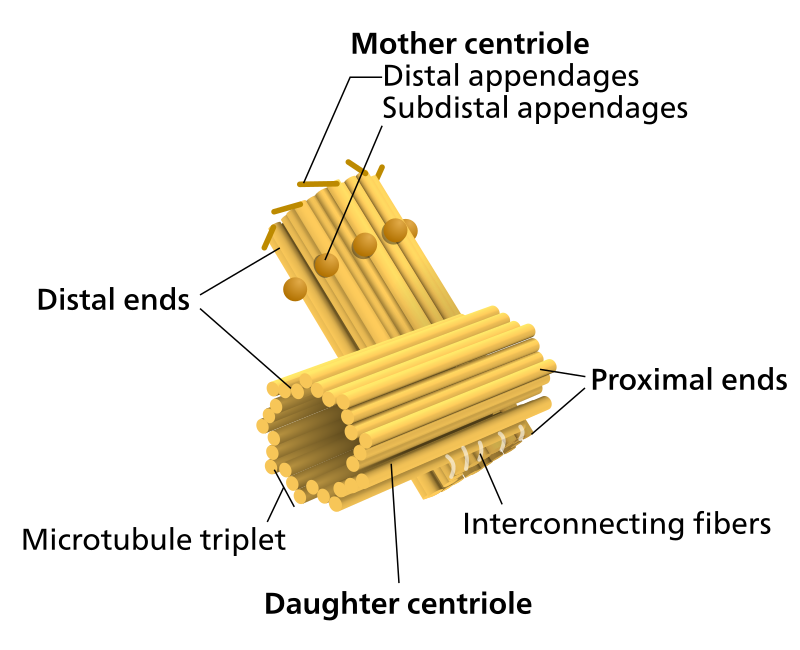
  • Centrosomes(The Centrosomes is the main place where the cell microtubules is arranged and it regulates the cell division cycle).

                                         Image result for centrosomes
  • Mitochondria(The Mitochondria acts as a powerhouse by providing energy to the cell, which is produced during the conversion of NADPH to Atp).

  • Ribosomes(A place for the synthesis of proteins).


  • Cytosol(The Cytosol is the liquid matter within the cell on which all the cell organelles are suspended in it except for the nucleus).
  • Cytoskeleton(The Cytoskeleton is a fibrous mesh-like structure that plays the major role by providing shape, structure, strength, stabilize tissue, anchors organelles within the cell, and has a role in cell signalling).


  • Vesicles(The Vesicles are the small spheres of lipid bilayer. They are used for transporting molecules within the cell from one organelle to another and also plays a role in the process of metabolism).


  • Cell Membrane(The cell membrane is the outer covering layer of the animal cell. Its function is to allow the passage of certain selective molecules in and out of the cell).

 Image result for cell membrane